|
|||||||||||
| About Us | Join Us | Records | Books | Top 10 | Articles | Productions | Operas | Events | Exhibitions | Contact Us | |
| Records: Classical, Semi-Classical & Ghazals | |||||||||||
|
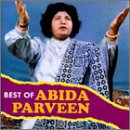
Title: The Best of Abida Parveen Artist: Abida Parveen About the Artist: Sample Audio: Track 1 | Track 2 (Coming Soon)
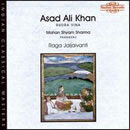
Title: Untitled Artist: Asad Ali Khan About the Artist: Sample Audio: Track 1 | Track 2 (Coming Soon)
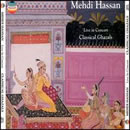
Title: Artist: Mehdi Hassan About the Artist: Sample Audio: Track 1 | Track 2 (Coming Soon)
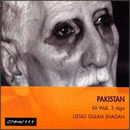
Title: PAKISTAN Artist: Ghulam Hussain Shuggan About the Artist: Sample Audio: Track 1 | Track 2 (Coming Soon)
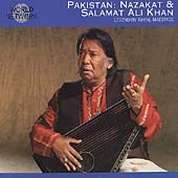
Title: PAKISTAN Artist: Salamat Ali Nazakat Ali Khan About the Artist: Sample Audio: Track 1 | Track 2 (Coming Soon)
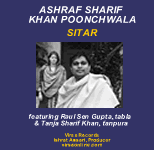
Title: SITAR Artist: Ashraf Sharif Khan Poonchwale About the Artist:
ASHRAF SHARIF KHAN POONCHWALE
Ashraf Sharif Khan Poonchwale represents the new generation of master sitar players from South Asia.Born in Lahore, Pakistan in 1969, he comes from a family of long classical music traditions. He trained with his father, the illustrious Ustad Mohammad Sharif Khan Poonchwale and gave his first sitar concert at the age of 10.Ashraf Sharif Khan belongs to the Poonch Gharana, which was established by his grandfather Ustad Abdul Rahim Baksh Khan at the court of the rulers of Poonch in Kashmire. What distinguishes the Poonch Gharana from others is the ang or style of playing. Most sitar players play in the sarod ang, while Ashraf like his father, blends the sitar in the veena ang, which emphasizes the meend or tie and gamak - a taan of dhrupad ang. This lends a tonal expression unique to the Poonch Gharana and Ashraf Sharif. Ashraf Sharif has performed extensively in Pakistan, United States, Europe, Japan and South Asia. Liner notes: Ishrat Ansari Sample Audio: Track 1 | Track 2 (Coming Soon)
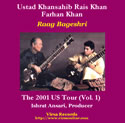
Title: Raag Bageshri Artist: Ustad Khansahib Rais Khan & Farhan Khan About the Artist: Ustad Khansahib Rais Khan
Ustad Rais Khan, who makes his home in Karachi, Pakistan, is one of the most gifted South Asian musicians of our times. The magical sound of sitar in his hands has enthralled audiences and made him fans all over the world. Born in 1939, Ustad Rais Khan descends directly from the court musicians of the Muslim Mughal emperors of South Asia, going back to the 15th century AD. He belongs to the Mewaat Gharana (School), which is famous for its "ang"(style of playing): the "guyki" ang. The tonal expressions in this style make the sitar "sing". Ustad Rais Khan is also an accomplished singer. Sometimes, at the end of a performance, he sings a composition and to the delight of his audience plays it on the sitar. There are very few musicians who can give such compelling demonstration of how closely vocal and instrumental music is linked. His father Ustad Mohammad Khan started his son's training at the age of two and a half. Being a child prodigy, he gave his first public performance at the age of five. Since then he has never looked back. He has toured extensively all over the world delighting packed audiences of thousands. Rais Khan has a compelling presence and develops a spontaneous link with all that have the pleasure of listening to him live. Farhan Khan: Born in January 1981, the young Farhan Khan is already one of the most stylish and accomplished sitar players of his generation. His father Ustad Rais Khan has trained him, both in sitar and surbahar or bass sitar. Farhan Khan gave his first performance, to rave reviews, at the age of ten. Since then he has accompanied his father throughout the world and amazed listeners with his virtuosity. Sample Audio: Track 1 | Track 2 (Coming Soon)
Title: Untitled Artist: Mohammad Sharif Khan Poonchwaley About the Artist: Sample Audio: Track 1 | Track 2 (Coming Soon)
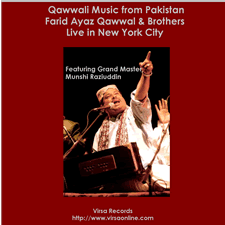
Title: Qawwali Music from Pakistan Artist: Farid Ayaz Qawwal & Brothers About the Artist:
Farid Ayaz Qawwal & Brothers Farid Ayaz Qawwal & Brothers sing the pure traditional form of qawwali. On their North American tour last year, the group developed a sort of cult following, especially among the young, cutting across cultural and linguistic barriers. Groups of both young and old would follow them from concert to concert. The group was formed by 82-year-old Grand Master Munshi Raziuddin, who has performed sacred music for over sixty years and passed on the art of qawwali to his eldest son Farid Ayaz and his younger sons. The classical qawwali singing of the group has been passed on from generation to generation going back to Ustad Khansahib Tan Ras Khan, who was the teacher of the last Mughal Emperor, Bahadur Shah Zafar. Farid Ayaz Qawwal and Brothers have promoted the art of qawwali throughout Pakistan, India, Iran, the Middle East, Europe and the United States.
Ishrat Ansari Sample Audio: Track 1 | Track 2 (Coming Soon)
|
|||||||||||
|
Copyrights � 2003 VirsaOnline.com All Rights Reserved |
|||||||||||